Thursday, July 14, 2011

News

I thought I'd start this post by sharing a joke from one of the students who went on the farm tour:

Q: Why did the farmer feed his cows money?


A: Because he wanted rich milk.


Good one, right.


Another student had a couple more questions about the cows that I thought I'd take a moment to answer. He/she wanted to know how much the cows weigh. The ones we have had to sell within this year weighed between 1050 and 1900 pounds. He/she asked what they eat. Our cows eat hay, corn, corn silage (which is the whole corn plant) and supplement. We have a nutritionist who makes sure our cows get everything they need to stay healthy and produce healthy milk. Where do the cows sleep, he/she asked. The cows that are milking sleep in the barn on sand bedding. The cows that are not milking usually sleep in buildings on straw or corn stalks or out on pasture. Calves that have not been weaned yet sleep in hutches, which are like little houses. I have a picture of some new ones we just got further down in this post. His/her final question was how many times do you milk them? We milk our cows twice a day, but some other farms milk three times a day.


This post is called "news" not so much because there is a lot going on here beyond the normal, but because we have been blessed with some updates in our operation this summer. The first of these is a round baler and wrapper, pictured below. The quality of our feed affects our entire year, so these are an effort to improve that. The wrapper is very cool. You set a bale on it and it spins and wraps all by itself. I like sitting and watching it work.


They poured a feed area where we can load the feed wagon without wasting so much feed. Eventually we would like to add a roof so any leftover feed would stay dry in wet weather.


We purchased some new calf hutches to keep the calves comfortable. They have built in water and feed buckets and bottle holder. The vent in the back helps keep them cool in the heat, but closes to help keep them warm in the cold.


Finally, we got a couple new kittens. Their names are Quarter and Cody. They are black and white just like most of our cows. A great fit for our farm.

Wednesday, April 27, 2011

A Tour

Last week an area school visited our farm. It was our first farm tour and we really enjoyed it. Afterwards they sent us wonderful thank you notes, which let us know their favorite things about the visit. We will be sure to keep petting the calf and experiencing what the milking machine feels like part of future tours as much as possible. A couple of the notes had some questions I thought I would take a minute to answer.


Q: How old are the cows?


A: The cows in the milking barn range in age from two years old to around 12 years old.


Q: Can we visit you again sometime?


A: Of course!


Q: How many cows do you have on your farm?


A: We have 76 milking cows and 67 heifers and calves for a total of 143.


Q: Do you have any dangerous cows on your farm?


A: Well, all animals can be dangerous at some point, but we don't keep cows that are consistently dangerous. We don't want to get hurt.


Q: Is it fun on your farm?


A: We think so.


Q: How much time does it take you to do all your work?


A: On a daily basis there is someone working about 10 and a half hours of the day. During planting and harvesting that increases to about 16 to 18 hours a day.


Q: Did you buy the cheese stick or make it?


A: It was given to us by our cooperative to give to you. They are cheese sticks you can buy in the store. There are some dairy farms that process their own milk, but we don't do that.


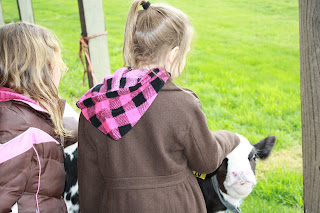
Hopefully that answers everyone's questions. Thank you so much for coming to visit! Here is a picture of a couple of the students participating in one of the classes' favorite activities of the day, petting the calf. This one's name is Zion.


Monday, March 21, 2011

Named


She is named Versace! Thanks for your help.

Saturday, March 12, 2011

New Life

This is a picture of our newest calf. She was born on Friday, March 11, 2011. You get to help name her! Vote in the poll on the right to choose a name. Her mother's name is Dior. I'll announce her name next week.

Tuesday, February 1, 2011

Raging Winter


I figured there isn't a better time to publish a post about what life is like in the winter than when a blizzard is raging outside. I love winter, but then I don't have to work outside in it as my husband often reminds me.
To him winter means more work trying to keeping animals warm enough and comfortable with a warm barn, dry bedding and dry udders. Our barn is pretty open to take advantage of the breezes in warmer weather, so we put boards on it in the colder months to keep the cows warmer. We always strive to provide dry bedding, but it is especially important in the winter or you start getting sick cows. In the warmer months you don't have to worry about drying off the udders as much, but in the winter if you don't get every teat dry enough they could freeze and become unmilkable. Newborn calves also need extra care to keep them alive.
Machinery being what it is requires more work to keep it working in the winter. Forgetting to plug in a tractor can mean more work either changing tractors around or doing the work by hand. And it is just plain harder walking to all the places outside where work needs to be done with 30 pounds more clothes, ice all the way except for when it is broken up by snow drifts.
It sure is a good thing winter can be absolutely beautiful. The snow makes everything quiet and white and it just gives one a cozy feeling doesn't it?

Friday, October 22, 2010

The things of Fall

You know its Fall here when the combines are rolling and the cows are putting on their winter coats. This year we are trying storing our corn in bags so we don't have to pay the storage fees and because we plant a conventional corn (not genetically altered) and when you store your crop, you don't necessarily get your crop back.
Here are some pictures from putting the corn in a bag.


The setup.


Watching it flow from the gravity wagon into the auger.
Helping it flow correctly into the bagger.
This last week they mowed the corn stalks in the field they just finished combining, raked them, hired them baled and today they are bringing them home. (The farm we plant the corn we combine on is about an hour away by tractor.) Next week they will work on discing the field so hopefully next year's crop yields more. Discing breaks up the soil so the plants have an easier time growing up out of it and spreading their roots through it.

Wednesday, September 22, 2010

Naming Calves

It is one of my jobs to name the heifer calves born on the farm. We need to do this because we register our cows so there is a record of their blood lines, which makes them worth more.

The first calves I named were also the first ones I saw born. They were twin heifers, named Speedy and Pokey because one was fast and one was slow. Original, I know. Then there came a calf who liked to jump over the top of the pen we had her in inside the machine shed. I named her jumpstart. And the process evolved from there. Pretty soon I discovered that it might be easier if I came up with "lines" of cow names. We had a cow named Vail, which just screams to be made into a line of ski resorts. Snowmas, Aspen, Hogadon all come from that line. A cow named Jade wanted to become a line of precious stones. Her offspring include Ruby, Pearl and Sapphire. You get the idea.

For a little while now I have been running short on different lines and even names within lines. For example, we now have a line of vegetables. I just named a calf Radish the other day. And the line of different bears is going to have to change soon. There really aren't very many of those. Another calf I named the other day is Adda for Adams like Grizzly Adams because her mom's name is Grizzly. See how far I'm having to stretch that one?

Here are a few pictures of some of our newly named calves.

This is Rhubarb. Her mom is an unregistered cow. Her sisters are Keylime and Coconut. She has one niece named Peach. She is part of the "pies" line.

The calf standing in the center of this picture is Nola. Her mom is Nadine. She doesn't have any sisters, but she has a great-grandma, grandma, aunts and cousins on the farm: Nellie, Niomi, Nicole and Nora. The calf standing to the side is Radish, whom I mentioned earlier. Her mom is an unregistered cow and she has a sister, Beet.

This is Spritz. Her mom is Sprinkle, her grandma is Teardrop, and her great-grandma is an unregistered cow. She has other family here including Pint, Ounce, Rain and Stormy.

And this is Rome. Her mom is Jumpstrt and her sister is Paris.

Saturday, August 28, 2010

Corn Silage

Last Saturday they finished corn silage, which was two day process this year. Corn silage is an important part of our cows' feed and we are continually looking to put up the best we can as it affects our cows and our milk check all year long. What is corn silage? It is chopped corn, including the stalk, cob and kernel.
We hire people to come chop the corn silage for us as they have a self-propelled chopper, which minimizes the number of rows we lose to tires. It also is able to chop eight rows at a time instead of two, speeding the job up dramatically.
They haul the silage off the field in chopper wagons that can unload onto the bagger belt.


This is a picture of a wagon unloading onto the bagger. The bagger takes the silage and puts it in huge bags to ferment.


The bags.


This is what corn silage looks like before it goes in the bag.


Today they started seeding for fall crops, which we will use to graze heifers. Thus the cycle continues of working to feed animals so they can provide the most nutritious food to the world.


Tuesday, August 10, 2010

Summer

Summer is a busy time of year on our farm. It is the time when all the projects that can't be done in the winter are completed. The time when hay is harvested and corn silage chopped. It also is the time when it is hot and humid; this year more so than most. Here are some pictures of how my children found time to just have fun and stay cool this afternoon.

A water tank looks very similar to a pool apparently.

Thursday, May 27, 2010

Why a Co-op?

Why do people belong to cooperatives? What do they offer that you cannot do for yourself?

We belong to a cooperative because we do not have the time to find a market for, schedule delivery and negotiate the price of our milk along with doing the work of the farm. Our co-op, Dairy Farmer's of America (DFA), does a great job of taking care of that end of the business for us. We also benefit from the numerous extras a co-op can provide it's member-owners. We have opportunites to learn more about the industry; have access to services like risk-management, information on how to best utilize grazing in our operation, and how to conserve more energy on our farms; as well as receive discounts on supplies because of the buying power of a cooperative.

It is important to remember that while the day-to-day business of a cooperative may be run by a few, the owners of it are many. Each member has an equal voice and vote in decisions being made. If they don't agree with the way things are going they can work for change or change the cooperative they belong to. Farmers are not held captive. They see the value a cooperative has in their ability to remain doing what they love to do.

Cooperatives also are of value to consumers because they set standards. They are agressive in setting standards for the quality of milk they will pay for, for animal care and for sustainability to name a few. Cooperatives strive to make sure all their members have the information they need to produce the best product they can.

Cooperatives exist for a reason--they benefit society, through those who belong to them and those who purchase the products they offer.

Thursday, May 13, 2010

Planting

The crops are in and growing. We plant forages, like grasses, oats and alfalfa, as well as corn. Almost all of which we use to feed our cows.

I never realized the work it takes to plant a crop until I married a dairyman. Honestly, I didn't know much about agriculture at all until I married into it and the learning curve has been steep. For instance, cows have to have a baby to produce milk, just like humans. To some this may seem like commonsense, but to someone like me, who had no ties to agriculture before getting married, it is not common. I also learned there are steps to planting. We till or break-up our soil before we plant, then apply fertilizer (plant food) if the soil is low on minerals the plant needs, then plant the seeds and then the hardest part-we wait and hope the weather is favorable for a good start and good growth.

Our whole year of milk depends on the quality of crop we produce because cows are sensitive to changes in their diet and need good nutrition to keep them healthy. Because of this, we work closely with a dairy nutritionist to make sure that they have everything they need to stay healthy and produce a quality product. If the nutrients the cows need aren't in the things we grow, we have to spend more money to add them as supplements. (Kind of like taking vitamins.) We work hard to keep our costs down, as overhead can kill you in a small business.
Here are a couple pictures of planting a couple weeks ago. The tractor on the left is breaking up the field with a disc to get it ready to plant. The tractor on the right is planting corn.

Sunday, April 18, 2010

Start of Spring

You know it is spring when you see the tractors rolling on the road and in the fields. The cows are being moved to their pasture for the summer and they are starting to lose their winter coats. I went strolling around the farm today to take in some of this springness.

Our tractors have been rolling right along with those of our neighbors. My husband has been working long hours this last week in an effort to take full advantage of the dry weather. Last year we had only a short window of weather that allowed us to plant. Unfortuantely, he had to haul manure that week and thus we didn't get all our acres planted until June. Entirely too late. This year God has been good to us. We already have one farm planted (60 acres of corn), even though we still had to harvest about 20 acres of corn there, and the manure is hauled here at home. Hopefully we will be done planting early this next week. As my husband says, "that is the goal, anyway." If he meets his goal, this will be the earliest he has been finished planting since we got married six years ago. Perhaps more than any other profession weather is a major player in getting your work done.

Here is a picture of the calves we have out on pasture so far. You might notice that there is lush green grass right behind them. They, however, prefer to lay in the dirt. Much like kids I guess.

Friday, April 9, 2010

Caring

I was reading a newspaper article yesterday about the poultry industry, which I know very little about but feel a certain kinship to as they are in the business of animal agriculture too. It reminded me of things in the dairy industry that are under close scutiny right now, like tail-docking and de-horning. Tail-docking is where part of the cow's tail is removed to promote cleanliness and safety for the cow and those who work with her. De-horning is the removal of the cow's horns also done for the safety of all the cows and those who work with them.


More troubling to me than whether these practices are continued is the idea that farmers don't care about their animals. This is not true. Farmers do care about their animals. I have heard many tell about "tearing up" when they had to put their favorite cow down or sell her for slaughter. They grow attached. They care. Most farmers do their best to care for the animals on their farms in the best way possible. This looks different on every farm, but healthy, content cows are what we strive for. In a purely economical sense, uncomfortable cows don't produce as much milk so why would we want to make them uncomfortable? Not to mention that caring for them to the best of our ability is just the right thing to do.

We do our best to make sure that our cows are healthy and comfortable. All the people in dairy I have met do the same. Most are not like the video exposes we see on the news, but are honest, hardworking farmers trying to provide their family with a quality life and their customers with a quality product.